
The Stone Tape and the Picture Reel: Folk Horror and Film Matter by David C. Porter
In 1837, in his Ninth Brigewater Treatise, Charles Babbage declares that “No motion impressed by natural causes, or by human agency, is ever obliterated.” Over a century later, in the 1972 film The Stone Tape, written by Nigel Kneale and directed by Peter Sasdy, we hear a character declare that “the room holds an image, and when people go in there they pick it up. […] It must act like a recording, fixed in the floor and the walls, right in the substance of them, a trace of what happened in there, and we pick it up, we act as detectors, decoders, amplifiers… it would have to be in the stone.” The rhyming nature of these statements, I believe, is not coincidental. My aim here is to demonstrate how this film, The Stone Tape, reframes 19th century spirtualistic theories of matter such as Babbage’s in the context of 20th century technological paradigms and the generic conventions of folk horror, and how from this a model of both film spectatorship and the materiality of film itself emerges – one which is, given its provenance, appropriately spooky.
Kneale and Sasdy’s film played a significant role in popularizing the idea (to the extent that this idea ever became popular) that psycho-sensory impressions could be “recorded” by inert material, in particular by certain kinds of stone, significant enough that it’s sometimes mistakenly believed to have originated it, but as the Babbage quote should indicate, this is a conceptual thread which can be traced back to far earlier sources. Its full history is obscure, complex, and beyond my scope here, but it could be thought of as a particular form of psychometry, a parapsychological practice based on “reading” the history of an object through direct physical contact with it. The term was coined in the 1840s by Joseph Rodes Buchanan, an American physician who believed, quote, “The Past is entombed in the Present!” and that in the future “the psychologist and the geologist will go hand in hand.”
There are two things I want to emphasize here: first, that a “stone tape” is essentially a 19th century idea, emerging from the same early Modernist stew as photography and, by extension, cinema; and second, that the language used to describe it could, with only minor tweaking, pass for writing on cinema from decades later. It’s not that the concepts are inextricably intertwined, but rather that they must be recognized as emerging from similar sociocultural contexts, and embodying similar interests.
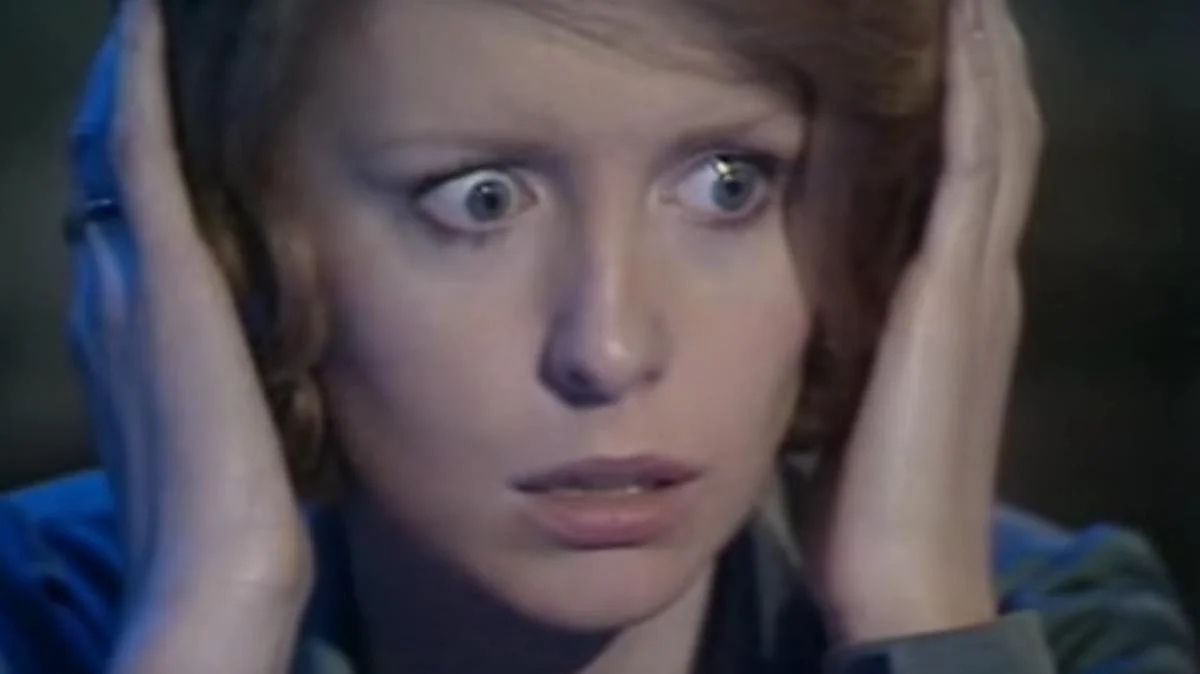
Given this, it should be clear that in the concept of a stone tape there is substantial potential for developing something akin to a theory of cinema. To see how we get from here to there, let’s examine Kneale and Sasdy’s film in a bit more detail. Made for the BBC in 1972, it centers on a team of corporate electronics researchers who have taken up residence in a large manor house, disused since the War, to try and develop a new recording medium, superior to magnetic tape. When they arrive, however, they learn that their would-be computer storage room has not been refurbished as expected. The workers refused. Enraged, the lead of the project, Peter Brock, goes to investigate, and, in the process, accidentally uncovers an old stairwell that seems to lead to nowhere. Jill, the computer technician of the team (it’s worth remembering that in the ‘70s, the actual operation of a computer, like the loom before it, was regarded as “women’s work”), sees the image of a woman at the top of the stairs, and hears her scream horribly. Soon, Brock and most of the others have has similar experiences in the room, although it’s clear that Jill is the most “sensitive” to it. Brock, a driven, overbearing empiricist, becomes interested in the phenomena, attempts to document it, and eventually throws their entire state-of-the-art technological arsenal at it.
Note the divergence here from an important convention of many stories of ghosts and hauntings: this is not a narrative of belief vs. non-belief. The “reality” of the phenomenon is quickly and readily accepted, even by those who can’t personally sense it. In this film, as in the writings of figures like Babbage and Buchanan, the paranormal is to be approached with a scientistic mindset, if not a strictly scientific one. But in the film, as is generally the case in real life, this approach proves to yield little. Tapes record silence, cameras capture emptiness, sensors read as normal, even though almost everyone there has at least heard something. Soon, Brock has the breakthrough quoted at the beginning: that it must be a form of recording, picked up by the mind directly without conventional sensory-technological interface. He becomes convinced that this is the breakthrough new recording medium they have been looking for, if only they can determine the principles by which it operates.
Jill has some doubts, though. She’s still troubled by the actual nature of the “recording.” By this point, they’ve long since determined it’s of the moments leading up to a servant girl’s death, falling from the steps. Jill can’t help but wonder if there’s still something of the girl herself left in it, if it’s really just an ephemeral trace. And furthermore, the fall shouldn’t have killed her: the stairs just don’t rise high enough. She can’t shake the feeling that there’s something important they’re disregarding in their excitement over the commercial potential. But she pushes these fears down and Brock, having overstated to the head of the company how close they are to a working prototype, soon leads an all-night assault on the room, blasting it with noise and light in an attempt to manually trigger “playback.” At the end of this, though, the room feels different, empty somehow, and it’s clear that all he’s succeeded in doing is “erasing” the recording. The project is given up as a failure by everyone except Jill, who still senses something in the space, something different, older, much older. Learning that the stones in the room far predate the rest of the building, possibly by thousands of years, she begins to develop a theory that the recording must “degrade” over time, and that although the servant girl’s recording has been destroyed by their experiments, they might have uncovered an earlier one which still exists beneath it, in a much more corroded form. Brock, however, feeling frustrated and defeated at his failure (so many bad decisions in this film are the product of male ego), brushes her off and sends her on leave. Everyone’s packing up, accepting they’re going to leave empty-handed. Before she goes, however, she’s drawn back to the room one last time, and finds herself confronted there by indistinct shapes, shapes which drive her, terrified, up the stairs onto an impossible, towering ledge, a ledge from which she falls and dies. The film ends with Brock visiting the room one last time, after it’s been marked off as a site for historical preservation, and hears its new recording, a recording, of course, of Jill’s final moments.
As this synopsis should suggest, it’s difficult to not see the room as a sort of technological artifact, one with which comparison to cinema is essentially unavoidable. Film is, after all, also a medium which captures ephemeral traces and plays them back to a semi-passive consciousness. In this context, what the stone tape does, as it’s depicted in this film, is to manifest objectively what is implicit and unspoken in the subjectivity of the cinematic spectator, namely that the same phenomenal input can be received in radically different ways, and that this reception is fundamentally inaccessible to empirical measurement. But it goes a step beyond this, too: not only is it inaccessible, but there is a Faustian dimension in attempting to overcome this. It is more or less clear what it does, but “why?” and “how?” are dangerous questions. The danger of seeking or discovering certain kinds of knowledge is a common theme of folk horror, but by staging this lesson with an apparatus somewhere between the demonic and the cinematic and applying an overtly technological, empiricist framing to it, the film encourages us to think about cinema itself in these terms. One may be inclined to recall photography’s early reputation as a stealer of souls, a technology capable of entombing not only the image of the past but its Being along with it. The real spookiness of the film, however, is that it suggests the exact opposite of this: that Being, soul, spirit, whatever you wish to call it, passes quickly, but an empty shell, a hollow image of the self, persists, pantomiming endlessly until it degrades into shapeless horror. This resembles the degeneration of film itself, a record of life and motion which in its slow decomposition becomes steadily more blurred and abstracted until the moments it once contained are rendered illegible. By depicting even the ancient and unknowable “stone tape” as incapable of indelibly preserving that which it captures, the film suggests that, contrary to the ambitions of Brock and his team, and by extension the whole project of technological Modernism, the ephemerality of movement and sensation cannot be overcome. All recording mediums contain within themselves their own reduction into base elements. Any unique, humanly recognizable detail is contingent and temporary. Contra Babbage, not only can motion be obliterated, but from the very moment after it occurs its obliteration has already begun to inevitably unfold. In a recording, Kneale and Sasdy’s film seems to suggests, something has always already been lost, and this loss is exacerbated with each passing moment, the already-inaccessible Real eternally slipping further into the shadows. It suggests a model of cinema as a haunted echo of what it seems to depict, and of the spectator as a receiver which will never pick up a clear transmission. It suggests cinema as a practical demonstration of that first and final truth, the one we spend our lives pretending not to know: that all will be forgotten someday.