
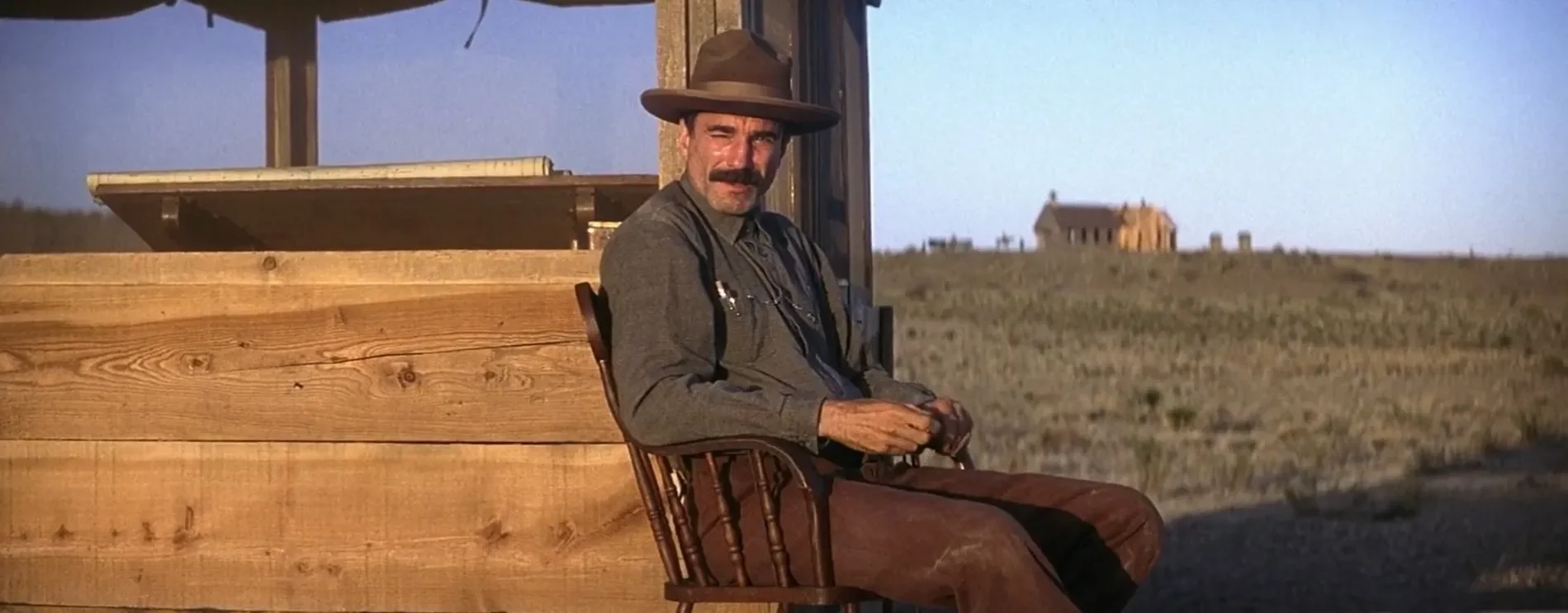
A Removal in There Will Be Blood Second Draft by Joshua Curran
In an early script for Paul Thomas Anderson’s 2007 film ‘There Will Be Blood’, there is an extremely revealing line of dialogue spoken by the main character, Daniel Plainview, which is absent in the final film. In an emotional, drunken exchange with a man he falsely believes to be his half-brother named Henry, Daniel admits that his ‘cock doesn’t even work’. This is a revelatory piece of information, and its disclosure, and the manner in which it is disclosed, offers to the viewer a direct insight into Plainview’s mind that is otherwise closed off and guarded.
Plainview, throughout the film, is domineering to those around him and has an unquenchable thirst for not only his own success but the failure of others. He admits in both scripts that he has a ‘competition’ in him. In the early script he goes so far as to say that ‘I want to rule and never, ever explain myself’, though this in itself is not an explanation, only a description of his desire. We are left without a proper explanation for this behaviour until the reveal of his infertility. From the way his admission concerning his genitals is phrased, there is some ambiguity, however slight, as to whether he has any sexual functioning whatsoever or whether he just can’t father a child, but in the context of the rest of the film and his lack of interest in women, it is almost certain that he has no ability to perform sexual acts. In this early script, it is clear that he is insecure about this. In the conversation in which he admits this to the man pretending to be his half-brother, he asks the man if his own cock works and then comments on his father’s virility due to him siring a bastard. Later on, after the fake Henry has slept with a woman, Daniel comments on it again, bitterly saying that Henry must get his lust from their father - ‘sticking it in whatever you see’. It happens frequently enough, and in a short enough time span, that these recurring comments become impossible to ignore when considering Plainview’s character. Daniel is clearly insecure about his ability to perform, and any audience member familiar even remotely with Freudian psychology can draw some very apparent conclusions from these facts. Daniel’s desire to win in financial and social battles is caused by his insecurity about his penis. His hyper-competitive external masculinity is caused by a feeling of internally justified inferiority. He can’t succeed at one of the main things that society expects a man to be, and so he must not only win at the other things but triumph in a way that causes all other men to fail, in the same way that he fails in areas where they might succeed. He explicitly states ‘I want no one else to succeed’. With the additional knowledge of his own shortcomings, it’s easy to see why the character feels that way.
These moments in the script come interspersed with scenes of Daniel grappling with his turbulent relationship with his own adopted child. In one scene, the son, H.W., starts a fire in the cabin where all three of the Plainviews are staying. Following this, Daniel chooses to send H.W. off to a boarding school, and then reacts explosively to a representative of Standard Oil talking innocently about Daniel’s son. The man’s suggestions that Daniel could retire from the money he would receive from a deal with Standard Oil and use his time to instead care for his son are met with threats of violence from Daniel. These scenes are all in the final film, but in this earlier script the theme of fatherhood and intergenerational relationships are much more front and center, with the contrast of Daniel’s feelings of insecurity and resentment regarding his own father and his feelings of guilt about his son highlighting each other, sexuality and parenthood intertwined.
So why did Anderson remove this extremely important and revealing piece of information?
The final Plainview that we get is much more of an enigma. Anderson didn’t necessarily remove Plainview’s infertility from the ‘canon’ of the film, but he did remove the absolute confirmation of the infertility and Plainview’s overt insecurity about it. It’s still completely justifiable to view Plainview as insecure about his (lack of) sexuality. Every point made in the above paragraphs about it is still a valid interpretation of the movie and the character. And that’s just the point – it’s a valid interpretation, but it isn’t necessarily the only, or even the most obvious one, in the final film. However, in the earlier script, it is almost inconceivable to view Plainview’s motivations as anything but a reaction to his psychosexual feelings of inferiority and his anger towards his father. His need to dominate those around him and to win while causing others to lose can, in the earlier version of the script, not be read as strongly as a commentary on the forces of capitalism and expansionism and all-consuming need for constant profit growth, but rather down to his individual psychology. Any other interpretation would be fighting an uphill battle, could be easily dismissed, and may not even be considered by most viewers due to the pervasiveness of Freudian psychoanalytic literary criticism. In the final film, he may well be doing everything for these psychosexual reasons, but he also may well be doing them for any other reason.
There Will Be Blood is undoubtedly influenced by Moby-Dick. A charismatic, domineering, monomaniacal figure sets out to achieve a goal at the expense of everything else – sound familiar? One of the songs on the soundtrack of There Will Be Blood is even named after a line from Moby-Dick: ‘Eat Him By His Own Light’. The line in the book refers to oil – the narrator tells the reader how it is possible to eat the flesh of a whale while sitting in a room illuminated by a lamp fueled by spermaceti harvested from the same animal. One of the strengths of Moby-Dick is its openness to interpretation which allows it to transcend its own specific time, location, and culture. Ahab combats the whale despite its invincibility just like the Calvinist (which Herman Melville was) must wrestle with the possibility that an all-powerful God has predestined him to hell. And yet, the crew of the Pequod can also represent man’s fight against nature in a universe that he ultimately cannot beat. It’s also about racism, and culturalism, and capitalism, overhunting, pride, and just about anything else a reader can think of, there are many valid interpretations of what the novel is about and what each of the characters represent. An advantage that Moby-Dick has in this is being a six-hundred-page encyclopedic novel, allowing it to explore many more topics than could be covered by a shorter book or movie with a narrower scope. But aside from this, many of the core characters and plot points are ambiguous enough that they can be interpreted in many, equally valid ways. Because of this, Moby-Dick can’t be put in a box and said to be that it specifically represents one thing and one thing only, and this is what has allowed it to become hailed as one of the great American novels. Similarly, There Will Be Blood’s defiance of a singular ‘correct’ interpretation works in its favour.
The decision to exclude Plainview’s explicit infertility and overt insecurity about his sexuality is for the betterment of the movie. The inclusion of it would bias the audience much too much to one singular interpretation of his character and the film as a whole. The ambiguity of it in the final piece allows for a much wider range of things Daniel can represent, giving the movie a richness that would be lacking if the audience was given a clearer reason for why Daniel is the way he is. The Plainview we see isn’t necessarily bound by human psychology but can transcend this to become representative of market forces, or of base human greed, or of anything else the viewer can come up with including those feelings of inferiority that overtly fuel him in the early draft. This indefinite quality is (among many other things) what makes There Will Be Blood such a compelling piece of art.