
The Irishman and the Pursuit of a New Filmic Language by Griffin Del Prete
A feeling of apathy sets in when you open up a streaming platform. The sheer amount of ‘content’ on display is able to turn even the most discerning viewer into a drooling mess, endlessly looking for the right piece of media. Anything to make the world outside a little bit less frightening for a few hours. There is so much to forget. So much accumulated history, such a hollow world. Everyone must forget the role they played in creating it, and there is no better way to forget than by reenacting it over and over again. Frank Sheeran, the titular ‘Irishman’ begins recounting his story. It is the end of American subjectivity, to a generation defined by a specific relationship to media and politics this means the end of days. A detachment from physical reality that takes the form of a hallucinatory trip back through the history of 20th century labor. Frank says that he killed Jimmy Hoffa, he says that he killed a lot of people as an enforcer for the teamster boss in the latter half of the 20th century. On its surface the film is a straightforward whirlwind of boomer nostalgia and paranoia. Winks are made at the audience as the failed invasion of Cuba and JFK assassinations are referenced rather overtly. Yet the formal elements of the film, specifically its use of de-aging and CGI reveal a deeper, more subtle thesis on the part of Scorsese in his last nod to American criminality on a grand scale.
As The Irishman was released to Netflix and limited theaters in late 2019, the world lurched towards an event that would massively reshape the way humans interact with media, politics and one another. I remember talking to some viewing it as a ‘mini series’ finding the best stopping and starting points from other eager fans on reddit or youtube. I first watched the film's opening scenes on my phone in an airport waiting to get home for thanksgiving, unable to resist the urge to watch a new Scorsese epic at that very moment. Something that should have been special and demanded a constant dedication of my attention had now been reduced to just another thing that existed on my phone. The film itself moves at a pace that is not alien to Scorsese’s work. It establishes a sense of momentum and movement, a dynamic camera that maintains continuity with the cinematic language of Goodfellas and The Departed. Scorsese makes nods to anxieties around government surveillance in The Departed. If he was feeling weary of technology as we entered the new millennium, the Irishman reveals a concern with the complete decay of cinema’s ontological framework.
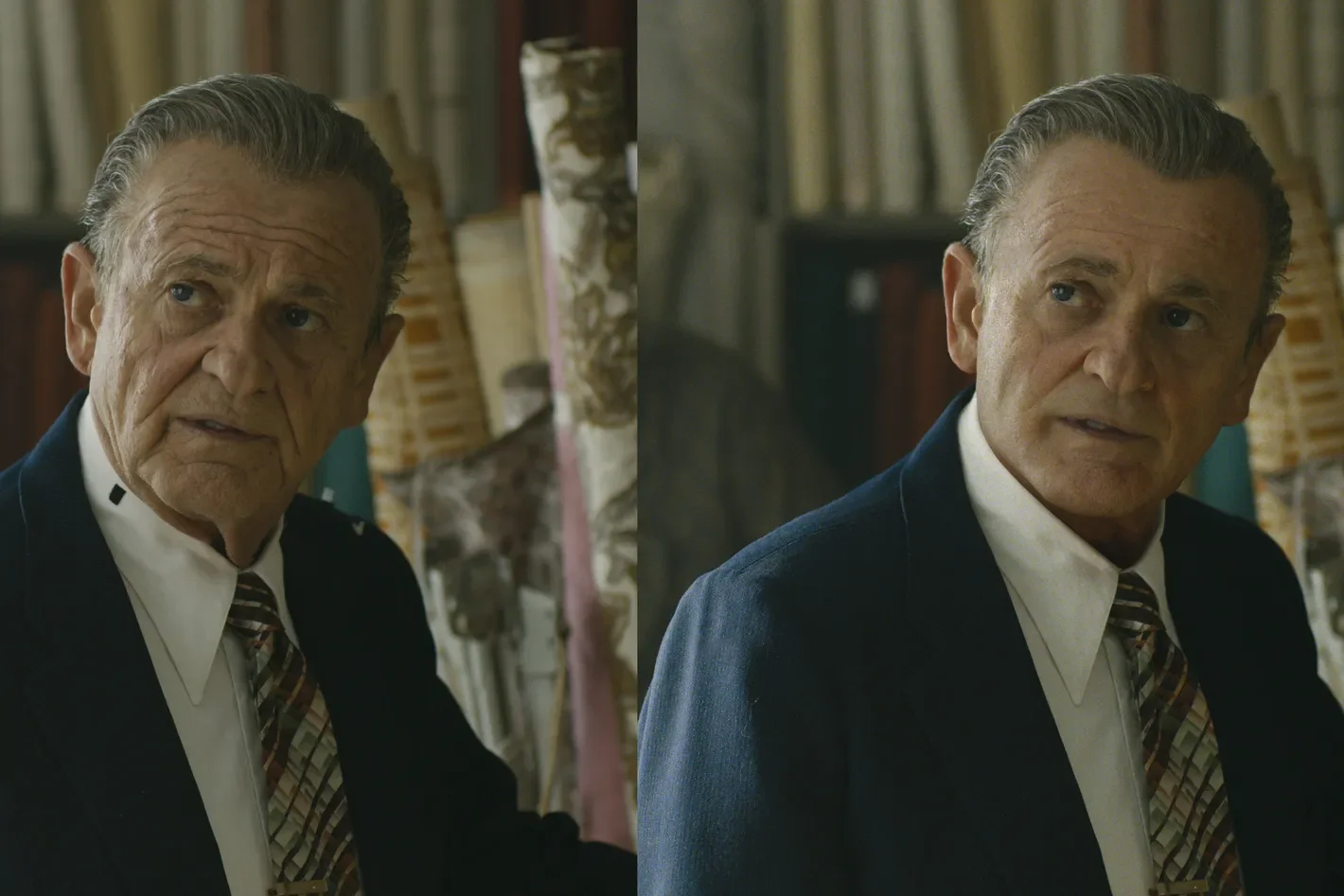
We are shown a version of two of American films' most famous leading men at the end of their lives, and then meant to believe minutes later that they are in their late 20’s. This proved to be too much for most viewers at the time of its release in late 2019. In the Irishman, age is something that can be manipulated like hue or saturation. Time itself becomes something of a play thing in the hands of the director. The audience's impulse was to stop it, start it, and stop it again. The film was consumed in days or weeks, not in hours. A bloated American media consumer convinced that closed captioning and earnest note taking will reveal the secrets to who killed Hoffa. The only way to watch the Irishman is by letting it overtake you. By letting it become your mode of seeing. Let it explain to you who is on screen and why, let it tell you who you are. On the cusp of large language models, the Irishman managed to identify in the culture a building pressure of contradictions and historical neurosis that exploded in the years that followed its release. Similar to Adam Curtis, Scorsese uses history to weave a cinematic web that reveals a deeper truth than mere historical fact could. By overwhelming the viewer with uncanny representations of American history he is asking everyone to sit and ask what was ever so real about America to begin with? Time chugs inevitably towards its conclusion. More of a fragmentation, a disintegration into millions of bespoke political ideologies. Every American is able to subtly manipulate the events of the 20th century to fit into their neat perception of reality.
Then in less than a year the Covid-19 pandemic would become a global event, and most people forgot what little impact The Irishman had managed to make on them. With the consolidation in film studios that has followed in the past six years, The Irishman serves as an example of what type of relationship film will have to its viewers in a world with shorter theatrical releases. In the age of great works of filmmaking being reduced to the living room, television viewers will have the power to control films for themselves, to view them on their terms. It starts as merely permission to take extra bathroom breaks, but for Scorsese it is easy to see how the events of history and the role of characters becomes malleable in this context. Film becomes more akin to a video game that unfolds before the viewer who assumes the role of a director and character themselves, able to pause, rewind, and eventually control the events on screen. Streaming and short form content has reduced history and aesthetics to an artificial blur, a constant sense that the uncanny influence of the digital is behind every piece of art no matter how ‘high’ or ‘low’ it may seem. When viewed this way, the actual content of the film fades into the background of a larger premonition on what cinema will become in the wake of massive digital onboarding events like the 2020 pandemic. The Irishman can be viewed not as a film but as just another thing on the internet. The same place where gambling and pornography exist alongside ‘explainer’ videos and AI generated images of hamsters riding unicycles. Most people self consciously deconstructed the film and viewed it in hour increments, indicating its place as one of the first in a coming wave of internet films.
The process of deindustrialization had already taken place by the time Scorsese released the films that have come to define him, Goodfellas and Casino were released in the 1990’s, a time when fragmentation had already begun to take hold in the film industry as smaller independent studios cropped up around Hollywood and New York. Now the degradation has seeped into the homes and minds of consumers of media. The last American export; culture, is now undergoing the same process on a more abstract level. In this sense The Irishman can be viewed as a never ending meditation on cinema itself in the age of digital media. A form of installation art that exists on the internet much like Nam June Paik’s Electronic Super Highway exists in the Smithsonian Gallery of Art, constantly radiating energy and meaning. Except where Paik’s works must be viewed in the particular time and space of a museum, The Irishman can be beamed to any device, or as I would imagine EVERY device in America or the world. The operatic decline of American capitalism, the retreat into artificiality can be viewed anywhere and everywhere. The Irishman creates a visual language that is itself an endless stream of information at a time when scrolling was becoming the go to means of consumption for most people. At the end of his career it is an attempt on the part of Scorsese to grasp at what could be coming next for cinema. Americans can remix and sample, create their own fragmented narratives of the death of Jimmy Hoffa. Provided they ever stop looking at their phones long enough to learn who he is in the first place.